Resource
Halloween Musicals for Kids That Keep Spooky Fun Sweet
The best Halloween musicals for kids balance light suspense with music, humor, and stories....
Learn MoreOrlando Family Stage
The Finest in Family Theater
Key Takeaways:
Children who participate in sustained arts programs develop stronger empathy, better writing skills, and improved behavior at school. Yet many families searching for acting classes still default to the most performance-heavy or prestigious-sounding option, assuming intensity equals quality. For a child who is shy, new to the stage, or simply curious, a high-pressure class could be the wrong fit. Theatre not only helps children become performers that you see on stage, but it also gives confidence to children who will become lawyers, doctors, artists, educators, and nearly every other profession that requires confident conversation skills.
The best kids acting classes in Orlando are not the ones with the most demanding auditions or the flashiest end-of-session showcases. They are the ones where a child feels safe enough to try something brave, and where that bravery is what gets noticed and celebrated. Belonging, it turns out, is the prerequisite for the creative risk-taking that theatre actually teaches. The strongest programs earn that trust in the same order: welcome first, then expression, then skill. Orlando Family Stage offers year-round camps and classes for students from pre-K through 12th grade and is built on exactly that premise.
Not every strong acting class looks the same, but the best ones share a common quality: they make room for a child to try, stumble, and try again without fear. The National Association for the Education of Young Children describes this as developmentally appropriate practice, where learning is strengths-based, play-centered, and paced to match where a child actually is. When comparing programs, it helps to look at how classes are grouped by age, how welcoming they are to beginners, and whether the culture rewards curiosity over perfection.
The right class is often the one where a child feels safe enough to speak up, move freely, and take a small creative risk week after week. Research from the American Alliance for Theatre and Education points to theatre education as a consistent driver of confidence, social connection, and academic engagement. Those outcomes do not come from pressure. They come from programs that build trust first and let skill follow.
A child’s first experience in a theatre class shapes how they feel about creative risk-taking for years to come. The strongest starting point is a class that treats a newcomer’s curiosity as enough of a reason to walk through the door, no prior experience required.
The structure of a beginner class matters just as much as what is being taught.
Here is what to look for in a beginner-friendly theatre class for children:
For families whose child is stepping into the theatre for the first time, the right starting point is a class where belonging comes before performance, and where every child’s first step forward is treated as something worth celebrating.
A four-year-old and a twelve-year-old are not just different in size. They are at entirely different stages in how they take creative risks. When those stages share a classroom, something predictable happens: younger students stop experimenting and start watching, quietly deciding that real performance belongs to someone older, someone more ready. Developmental research shows that younger children learn best through movement, imaginative play, and social interaction, while older students are ready to engage with text, character motivation, and peer feedback. Placing both in the same structure does not challenge either one. It teaches the younger child that theatre is something to work up to, not something that already belongs to them.
Programs grouped by age and stage create space for children to take risks alongside peers who are growing through the same things. Acting teachers report shifting their approach based on the age they serve, using games and perspective-taking activities with younger students and moving toward rehearsal and reflection with older ones. Orlando Family Stage’s Youth Academy builds this kind of progression in, offering pathways that grow with a child from early creative drama through to more advanced acting, audition prep, and musical theatre work.
Inclusion in a performing arts class is not just about open enrollment. It means the room is actively designed for children with different backgrounds, abilities, and learning styles to participate fully. Research from the NEA shows consistent links between arts engagement and stronger social skills, sense of belonging, and academic outcomes, especially for children who face barriers to access. When a classroom prioritizes empathy and representation over competition, every child benefits, not just those who arrive already confident.
Families looking at inclusive performing arts programs for kids should pay close attention to how a program communicates its values before the first class begins. Orlando Family Stage makes its equity and inclusion commitments publicly visible, and its accessibility offerings, from sensory supports to assistive listening devices, reflect those values in practice. A program willing to name these things clearly is one where your child is more likely to feel they truly belong, not just tolerated, but genuinely welcomed.
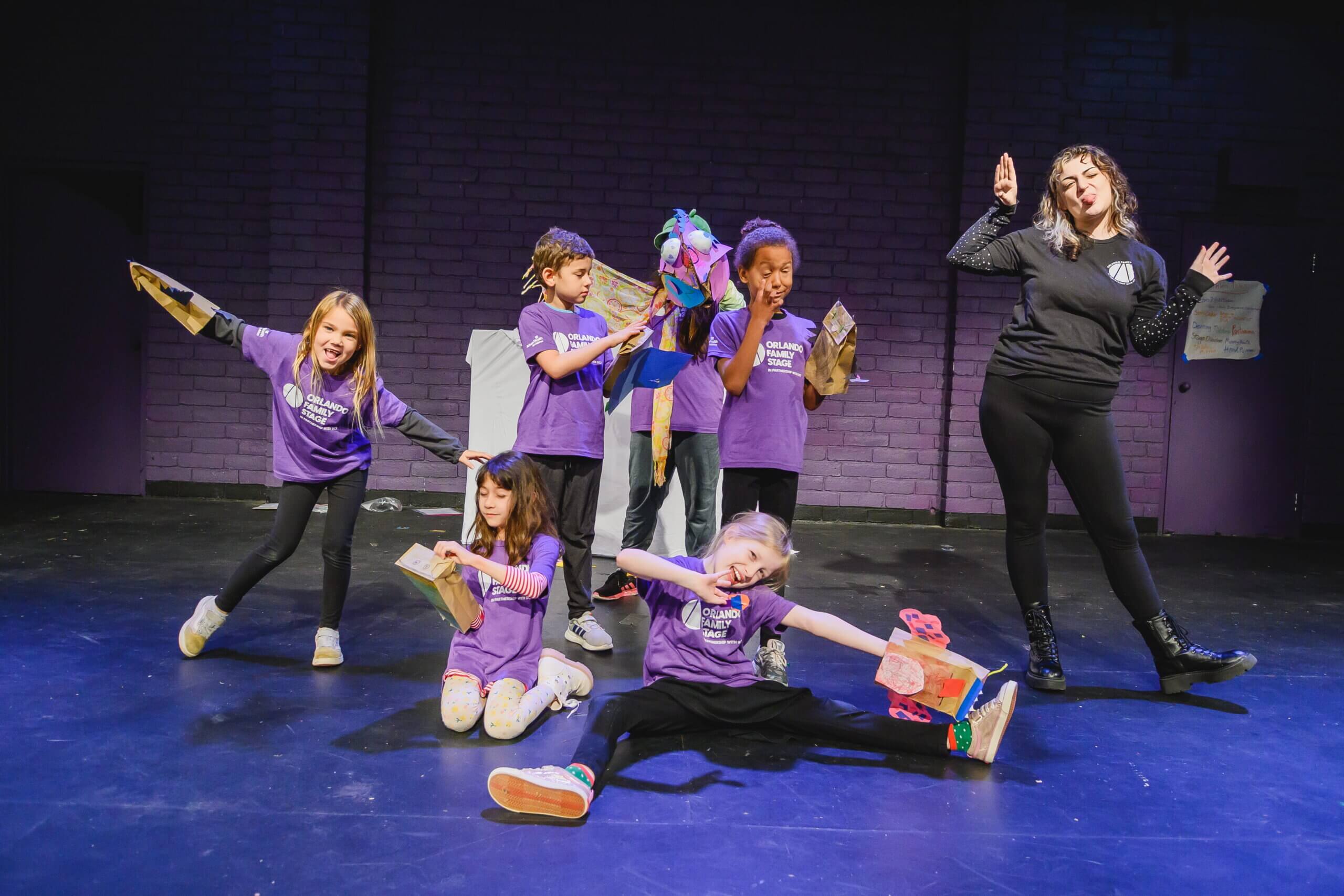
What children carry home from a great drama class is rarely a memorized monologue. It is the moment their idea sparked something in the whole group, or the time they took a risk and felt the room rise to meet them. That does not happen by chance. It happens when a class is built around expression and ensemble, not just performance. Those outcomes grow strongest when programs are well facilitated and developmentally tailored to the children in the room, not applied as a one-size-fits-all script.
What that looks like in a real classroom matters. The Kennedy Center connects drama directly to core social-emotional competencies like self-awareness, responsible decision-making, and relationship skills, all of which grow when children are given structured, playful space to speak, listen, and take creative risks together. For families who care about that kind of growth, here is what to watch for in a class:
The clearest sign a class is building something real is not a polished showcase. It is a child who walks out talking about what they tried, what surprised them, and when they get to go back.
For families who want more than a one-time experience, continuity matters. A program that can meet your child at age five and still have something meaningful to offer at fifteen is rare, and that staying power is exactly what makes Orlando Family Stage worth a close look.
Here is what sets this program apart for families thinking about kids’ acting classes in Orlando for creative growth:
What holds this program to a different standard is not the list of offerings alone. As Florida’s only professional theatre company dedicated exclusively to young audiences and families, Orlando Family Stage is not an arts center that added youth classes as a secondary offering. The entire organization exists for this purpose: to make the path from a child’s first creative instinct to a fully realized performance one that any child can walk, at any pace, from any starting point. That conviction shows in how the program is priced, how it places students, and how long it stays with them.
Choosing theatre classes for children in Orlando brings up real, practical questions, and the answers can look different depending on your child’s age, personality, and goals. Here is what families most often want to know before enrolling.
Most children are ready for creative drama as early as pre-K. Research from Americans for the Arts shows that early, sustained arts participation builds cooperation and emotional regulation across all backgrounds. Starting young with play-based classes tends to create a comfortable foundation before more structured skill work begins.
Look for programs that require no audition for regular classes and use games, ensemble activities, and storytelling before solo work. A beginner-friendly class prioritizes participation over polish. If a program’s language focuses on confidence and curiosity rather than performance readiness, that is a strong sign.
Strong inclusive programs communicate accessibility clearly and reflect it in the classroom, not just the marketing. Program quality and design matter as much as participation itself. Look for age-appropriate groupings, diverse representation, and teaching practices that make space for different learning styles and abilities.
Both build real skills, but in different ways. Year-round classes offer sustained growth over time, while summer camps provide immersive multi-day experiences that often accelerate connection and risk-taking. The right choice depends on your child’s schedule, temperament, and whether they thrive with consistency or respond well to full-week creative immersion.
Financial aid is available for Orlando Family Stage camps and classes, and families must apply before registering. One application is required per student per season. Aid is designed to make sure cost is not the barrier that keeps a child from the right program.
Among the best kids’ acting classes in Orlando, the assumption that intensity equals quality is exactly backward. Research shows that drama-based learning builds empathy, perspective-taking, and collaborative confidence, but only when the environment makes bravery feel possible rather than mandatory. A child who is never asked to take a risk they are not ready for is a child who keeps coming back, and it is that sustained engagement, not the single polished performance, that builds something lasting.
Orlando Family Stage Camps & Classes start from that understanding. Welcome comes first. Placement is thoughtful. The path forward stays visible and open for every child who walks through the door, including those who arrive quietly, uncertainly, and with everything still ahead of them. Financial aid is available for families who need it. The rest is simply showing up.
Don't miss out on the magic. Grab your tickets now and
make unforgettable memories at Orlando Family Stage!