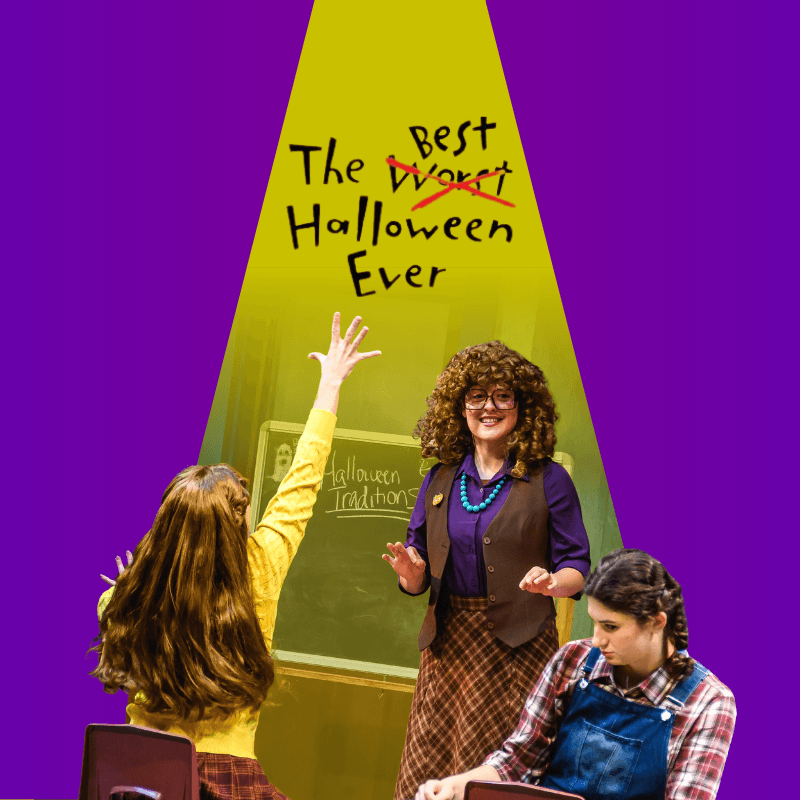
A world premiere based on the beloved Herdmans series by Barbara Robinson. Field trip performances October 5–30, 2026.
Everything on this page is free to use in your classroom before and after the show: themes, a full synopsis, discussion questions, and the Florida standards this experience supports. Project it, share the link, or print it straight from your browser. No downloads, no logins, no strings.
Big Themes
Watch for these five ideas onstage. They make great vocabulary words, journal prompts, or a scavenger hunt: ask students to spot a moment in the play where each one shows up.
Acceptance
Kindness
Flexibility
Traditions
Community
Short Description
Halloween is canceled, and everyone blames the Herdmans, the six siblings known throughout town for causing trouble. When Woodrow Wilson Elementary decides to host a supervised Halloween party instead, the students look forward to celebrating without the Herdmans. But strange things begin happening around the school, and no one knows what the Herdmans might be planning. As rumors spread and mysteries unfold, the students begin to discover that there may be more to the town’s most notorious family than anyone imagined. Filled with humor, heart, and plenty of Halloween surprises, this story explores belonging, empathy, and the courage to look beyond first impressions.
Play Synopsis
The full story, ending included. You’re the teacher, so you get to know how it turns out. If you’d rather be surprised along with your students, stop at the section titles.
Halloween Is Cancelled
Fifth grader Beth Bradley introduces the Herdmans, six siblings notorious for causing trouble around town. Ralph, Imogene, Leroy, Claude, Ollie, and Gladys lie, skip school, steal lunches, and Halloween candy, frighten other children, and have even been known to set fires. Every Halloween, they terrorize trick-or-treaters and take their candy. After another year of chaos, the mayor decides the town has had enough and cancels Halloween.
The children are devastated. Principal Crabtree announces that although the town will not allow trick-or-treating or other Halloween activities, Woodrow Wilson Elementary will host a supervised Halloween party. The students dislike the idea, especially when their teacher, Miss Kemp, turns the situation into an assignment about Halloween traditions. Imogene is particularly angry about losing trick-or-treating and candy.
Beth’s younger brother Charlie and his friend Eugene begin wondering what the Herdmans do with all the candy they steal each year. Convinced they must hide it somewhere, the boys decide to follow the Herdmans and investigate.
Preparing for Halloween
As the school party approaches, the students begin planning their costumes. Beth and her friend Louella hope to find costumes that can compete with Alice’s elaborate plans, while Boomer decides to use his grandmother’s old fur coat to dress as King Kong.
Meanwhile, Charlie and Eugene secretly follow the Herdmans at school. They discover candy hidden around the playground and overhear the siblings discussing the school party. The Herdmans decide they will not attend because they believe a supervised school event will ruin Halloween. Instead, they plan to make their own celebration.
Charlie and Eugene rush to tell their friends that the Herdmans will stay away from the party. The students imagine a Halloween without stolen candy, damaged costumes, or anyone getting shoved into lockers. Their excitement grows as they begin to believe this might finally be a peaceful Halloween.
At the same time, strange things start disappearing from school. The playground slide vanishes, followed by a wheelbarrow and other items. The students see the Herdmans with some of the missing property, but no one knows what they are doing with it.
The Mystery Grows
Charlie and Eugene become increasingly curious about the Herdmans’ secret candy supply. After calculating how much candy the six siblings might have collected over several Halloweens, the boys conclude that the amount would require a very large hiding place. They continue trying to solve the mystery.
The other students remain focused on the upcoming party. Alice plans an elaborate Christmas tree costume covered in electric lights. Louella has to wear a turkey costume her mother made while babysitting her baby brother, Howard, and Boomer prepares his King Kong costume. However, just before Halloween, Boomer discovers that his grandmother’s fur coat has mysteriously disappeared from the cleaners.
Meanwhile, Imogene visits Weezer’s Corner Market and discovers that the mayor has ordered the store to remove its Halloween candy. While there, she overhears Alice tell Beth that the school party will be better because the Herdmans will not attend. Alice calls it a perfect “Herdman-free Halloween.”
Imogene reveals that she heard them. Although Beth did not make the comment, she realizes that her silence hurt Imogene. Beth begins to feel guilty and wonders whether everyone has been too quick to see the Herdmans only as troublemakers.
Imogene’s Halloween
On Halloween morning, Miss Kemp invites students to continue sharing their reports. To everyone’s surprise, Imogene volunteers.
Imogene explains why Halloween matters to her. She says that children can enjoy Halloween even if their families cannot afford costumes or their parents do not have time to make them. She compares Halloween with other holidays, pointing out that not everyone receives a Thanksgiving turkey or Christmas presents. On Halloween, however, anyone can knock on a door and receive a treat. To Imogene, that makes Halloween a holiday for everyone.
Her report reveals a more vulnerable side of her and offers the class a glimpse into the Herdman family’s circumstances. Miss Kemp assures Imogene that she can still have fun at the school celebration, but Imogene insists that the Herdmans will not attend.
Before leaving, however, Imogene makes an ominous comment that leaves her classmates wondering whether the Herdmans have something planned for Halloween night.
Halloween Night
That evening, Beth dresses as a fortune teller and joins Louella, baby Howard, Charlie, and Eugene on the way to school. Strange church bells and other noises make the group nervous, especially because they suspect the Herdmans may be nearby.
Inside Woodrow Wilson Elementary, the adults have transformed the school with Halloween decorations and activities. Alice arrives in her light-up Christmas tree costume, while Boomer wears an improvised pirate costume because his grandmother’s fur coat is missing. Then someone dressed as King Kong appears wearing the missing coat.
The celebration quickly becomes darker and more mysterious. A skeleton decoration suddenly moves, the lights go out, and costumed figures begin appearing throughout the hallways. Two skeletons grab Charlie and Eugene and separate their two-person camel costume. Boomer chases the mysterious King Kong through the school.
Alice plugs in the lights on her Christmas tree costume and receives an electrical shock, causing a blackout! She remains conscious and later fully recovers. As Beth and Louella search the darkened school with baby Howard, dancing skeletons surround them and other Halloween decorations appear to come to life. The skeletons eventually carry Alice through a classroom doorway and lead the others deeper into the school.
Beth discovers that a bookcase conceals an opening in the floor. Behind it, she finds the missing playground slide leading into the basement. Charlie and Eugene call from below and tell Beth and Louella to follow them.
The Best Halloween Ever
Beth, Louella, and baby Howard slide into the school boiler room and land in an enormous pile of candy. They reunite with Charlie, Eugene, Alice, Boomer, and the other children. They also discover several of the school’s missing items, including the playground slide and wheelbarrows.
The room contains more candy than any of them could have imagined. Charlie and Eugene begin to suspect that they have finally discovered what happened to the Herdmans’ secret candy supply.
The children do not know for certain who created the surprise or why, but they happily celebrate together and declare it the best Halloween ever.
After Halloween
The next day, Boomer’s grandmother’s fur coat appears on his front porch with candy stuffed inside the pockets. Alice fully recovers from her electrical shock, and Louella uses the money she earned babysitting Howard to buy a costume she actually wants.
No adult can prove who planned the mysterious Halloween events or filled the school basement with candy. The children, however, believe the Herdmans did it.
Beth realizes that the children everyone expected to ruin Halloween may have been the ones who saved it. The Herdmans began the story as the reason Halloween was cancelled, but by the end, they create a celebration that includes everyone. When Beth thinks of Halloween now, she still thinks of the Herdmans, but for an entirely different reason.
Pre-Show Discussion Questions
The following conversation starters will help you think about the themes in The Best Halloween Ever, as well as make some predictions about the production itself.
Discuss the following before you join us at the theatre:
- How do you celebrate Halloween? What is your favorite tradition?
- What would you do if your town, city, or community suddenly canceled Halloween?
- Have you ever judged someone before really getting to know them? How would you get to know that person and judge for yourself?
- Have you ever tried being friends with someone, even when it was hard?
- The title of the show is The Best Halloween Ever. What do you think has to happen for it to be the “best ever”?
Post-Show Discussion Questions
We hope you enjoyed Orlando Family Stage’s production of The Best Halloween Ever! Discuss the following questions after attending the performance:
- What was The Best Halloween Ever about? Describe the beginning, middle, and end. What was the climax of the story? Why? How would you summarize the play in one sentence?
- What did you notice when you first entered the theatre? Describe the stage.
- What was the setting of the story? Did the scenery help establish the show’s location? What specific things did you notice about the scenery or stage lighting?
- What did you notice about the actors and their performances? How did they use their voices and bodies to bring the characters to life?
- Which character do you relate to the most? Why? What words describe that character?
- What was a challenging moment for a character? How did they respond, and what are some other healthy ways they could have handled their feelings?
Florida State Standards
Detailed list of Florida State Standards satisfied by using this guide and attending Orlando Family Stage’s production of The Best Halloween Ever.
Language Arts (B.E.S.T.)
ELA.K12.EE.1 Cite evidence to explain and justify reasoning
ELA.K12.EE.3 Make inferences to support comprehension
ELA.K12.EE.4 Use appropriate collaborative techniques and active listening skills when engaging in discussions in a variety of situations
ELA.K12.EE.6 Use appropriate voice and tone when speaking or writing
ELA.K.C.2.1 Present information orally using complete sentences.
ELA.1.C.2.1 Present information orally using complete sentences and appropriate volume
ELA.2.C.2.1 Present information orally using complete sentences, appropriate volume, and clear pronunciation.
ELA.3.C.2.1 Present information orally, in a logical sequence, using nonverbal cues, appropriate volume, and clear pronunciation.
ELA.5.C.2.1 Present information orally, in a logical sequence, using nonverbal cues, appropriate volume, clear pronunciation, and appropriate pacing.
ELA.6.C.2.1 Present information orally, in a logical sequence, using nonverbal cues, appropriate volume, clear pronunciation, and appropriate pacing.
ELA.7.C.2.1 Present information orally, in a logical sequence, emphasizing key points that support the central idea.
ELA.8.C.2.1 Present information orally, in a logical sequence, supporting the central idea with credible evidence.
ELA.9.C.2.1 Present information orally, with a logical organization and coherent focus, with credible evidence, creating a clear perspective.
ELA.10.C.2.1 Present information orally, with a logical organization and coherent focus, with credible evidence, creating a clear perspective.
ELA.11.C.2.1 Present information orally, with a logical organization, coherent focus, and credible evidence, while employing effective rhetorical devices where appropriate.
ELA.12.C.2.1 Present information orally, with a logical organization, coherent focus, and credible evidence while employing effective rhetorical devices where appropriate.
Theatre Arts
TH.K.C.2.1 Respond to a performance and share personal preferences about parts of the performance
TH.K.C.3.2 Share reactions to a live theatre performance
TH.1.C.2.2 Identify elements of an effective performance
TH.2.O.2.1 Re-tell what happened in the beginning, middle, and end of a story after viewing a play
TH.3.C.1.2 Watch a play and describe how the elements of light costumes, props, and sound influence the mood of the production
TH.3.C.2.2 Discuss the meaning of an artistic choice to support development of critical thinking and decision-making skills
TH.3.O.2.1 Describe what happened in a play, using age-appropriate theatre terminology
TH.3.S.1.3 Evaluate a performance, using correct theatre terms, and give specific examples to support personal opinions.
TH.4.S.1.1 Exhibit proper audience etiquette, give constructive criticism, and defend personal responses.
TH.4.S.1.3 Use theatre terms to evaluate a live performance and discuss the qualities that directly impacted the audience’s response to the production.
TH.4.S.3.3 Describe elements of dramatic and technical performance that produce an emotional response in oneself or an audience.
TH.5.O.1.1 Explain an actor’s choices in the creation of a character for a scene or play.
TH.5.O.1.3 Evaluate how an actor or designer’s choices about a character affect the audience’s understanding of a play.
TH.5.S.1.3 Evaluate a performance, using theatre terminology, and articulate emotional responses to the whole and parts of dramatic performances.
TH.68.S.2.3 Analyze the relationships of plot, conflict, and theme in a play and transfer the knowledge to a play that contrasts in style, genre, and/or mood.
TH.68.H.1.5 Describe one’s own personal responses to a theatrical work and show respect for the responses of others.
TH.912.C.1.3 Justify a response to a theatrical experience through oral or written analysis, using correct theatre terminology.
TH.912.C.3.3 Critique, based on exemplary models and established criteria, the production values and effectiveness of school, community, and live or recorded professional productions